

Hot Tub Wiring 101: Why You Need a Dedicated Circuit and GFCI Protection
![[HERO] Hot Tub Wiring 101: Why You Need a Dedicated Circuit and GFCI Protection](https://cdn.marblism.com/qdPiGN691-Q.webp)
You've finally done it. You bought the hot tub. You can already picture yourself relaxing under the stars with a cold drink in hand after a long day at work.
But before you start filling that bad boy with water, we need to talk about something that could literally save your life: the electrical setup.
Here's the thing. Hot tubs aren't like plugging in a toaster. They're powerful machines that pull serious electrical loads while sitting in hundreds of gallons of water. And water and electricity? They're not friends. They're enemies. Dangerous enemies.
At Steady-State Electric, we've seen too many DIY disasters and sketchy installations that make us lose sleep at night. That's why we're breaking down exactly what you need to know about hot tub wiring, specifically why a dedicated circuit and GFCI protection aren't optional extras. They're absolute necessities.
What Is a Dedicated Circuit (And Why Your Hot Tub Demands One)
A dedicated circuit is exactly what it sounds like. It's an electrical line that powers one thing and one thing only, in this case, your hot tub.
No sharing with the outdoor lights. No piggybacking off the garage outlets. No splitting power with anything else in your home.
Why so strict? Because hot tubs are power-hungry beasts. Most require a 240-volt, 50-amp breaker to operate safely. That's a massive electrical load. If you try to share that circuit with other appliances or devices, you're asking for trouble.
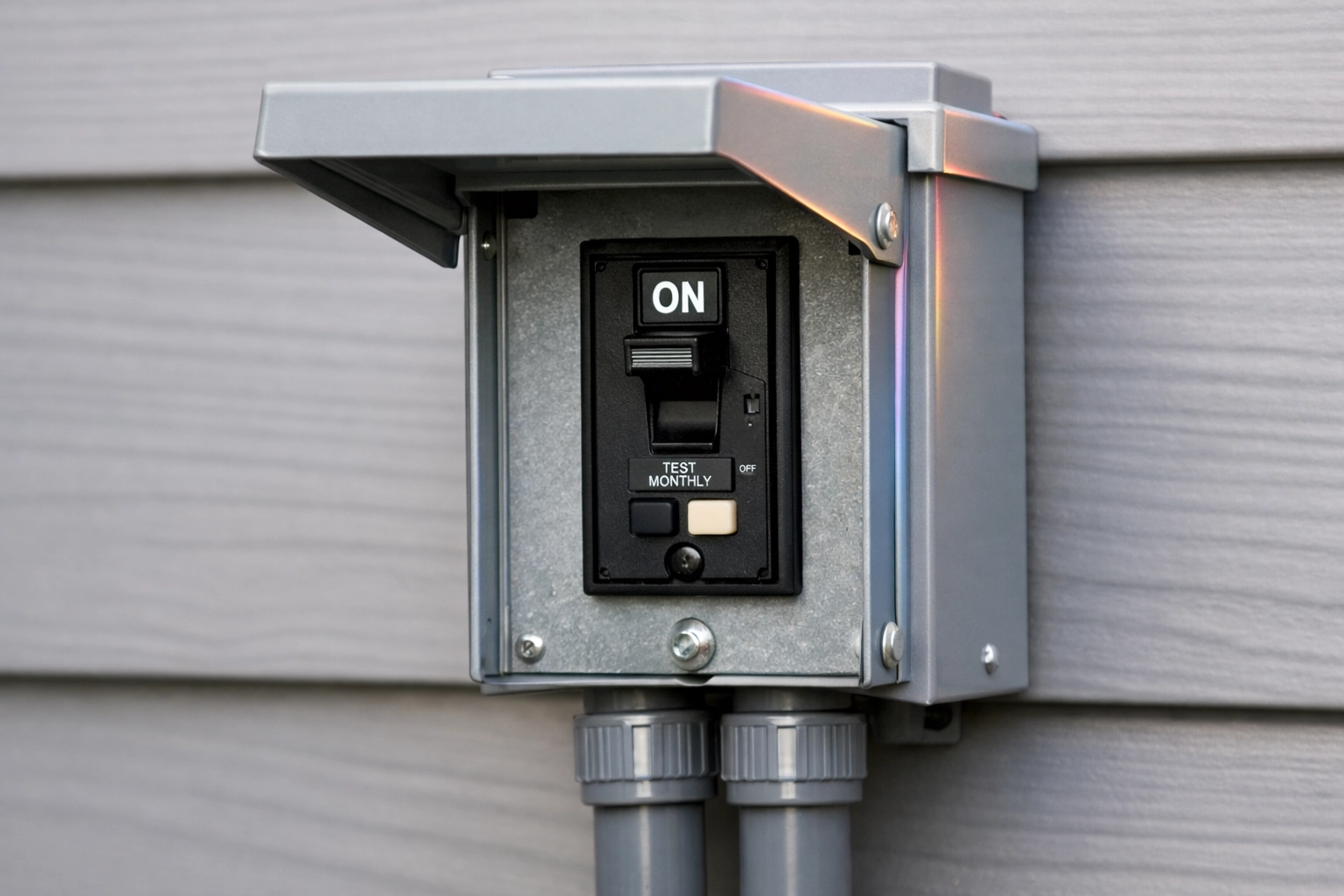
Here's what happens when you don't use a dedicated circuit: Your breaker trips. Constantly. You're making the walk of shame to your electrical panel every other day to flip that switch back on. That's called "nuisance tripping," and it's more than just annoying, it's a red flag that your circuit is overloaded.
Overloaded circuits create heat. Heat creates fire risk. And nobody wants their relaxation investment to become a safety hazard.
We do it right the first time. That means running a dedicated line from your main electrical panel straight to your hot tub. No shortcuts. No compromises. Just clean, code-compliant power that keeps you safe and your hot tub running smoothly.
GFCI Protection: The Safety Feature That Could Save Your Life
Now let's talk about the real hero of hot tub safety: GFCI protection.
GFCI stands for Ground-Fault Circuit Interrupter. It's a device that monitors the flow of electricity and acts like a lightning-fast security guard. If it detects even a tiny electrical leak: we're talking milliseconds: it cuts the power immediately.
Why does this matter? Because you're sitting in water. Lots of water. And water conducts electricity better than almost anything else.
Imagine this scenario: A wire inside your hot tub develops a small fault. Without GFCI protection, that electrical current could leak into the water while you're soaking. You might not even notice at first: just a slight tingle. But that "tingle" could quickly become a life-threatening shock.
A GFCI breaker or disconnect prevents this nightmare. The moment it senses that electrical leak, it shuts everything down. No exceptions. No delays.
This isn't optional, by the way. The National Electrical Code requires GFCI protection for all hot tubs. It's the law. And for good reason: it works.
The Water-Electricity Danger You Can't Afford to Ignore
Let's get real for a second. Water and electricity together create one of the most dangerous combinations in your home.
Your hot tub holds hundreds of gallons of water. You're immersed in that water. Your family is in that water. And all around that water are electrical components: pumps, heaters, controls, jets.
Even professional-grade hot tubs with quality manufacturing can develop electrical faults over time. Wear and tear happens. Connections loosen. Insulation degrades. It's not a question of if something could go wrong: it's a question of whether you're protected when it does.
That's where proper installation makes all the difference. A correctly wired hot tub with GFCI protection gives you multiple layers of safety. The dedicated circuit prevents overloads. The GFCI prevents shocks. And professional-grade grounding provides an emergency escape route for stray current.
We've seen installations where homeowners or unlicensed "handymen" skipped these critical safety features to save a few bucks. It's not worth it. Your life isn't worth gambling on cut corners.
What a Proper Hot Tub Installation Actually Looks Like
So what does code-compliant hot tub wiring involve? Let's break it down.
First, you need that dedicated 240-volt circuit we talked about. For most hot tubs, that means a 50-amp breaker in your main electrical panel. Some larger models might need 60 amps. Your hot tub's manual will specify the exact requirements.
The wiring itself typically consists of four insulated conductors running from your panel to the hot tub. Two hot wires (usually black and red), one neutral wire (white), and one ground wire (green). For most installations, we use #6 THHN-stranded copper wire. It's rated for the amperage and designed to handle outdoor conditions.
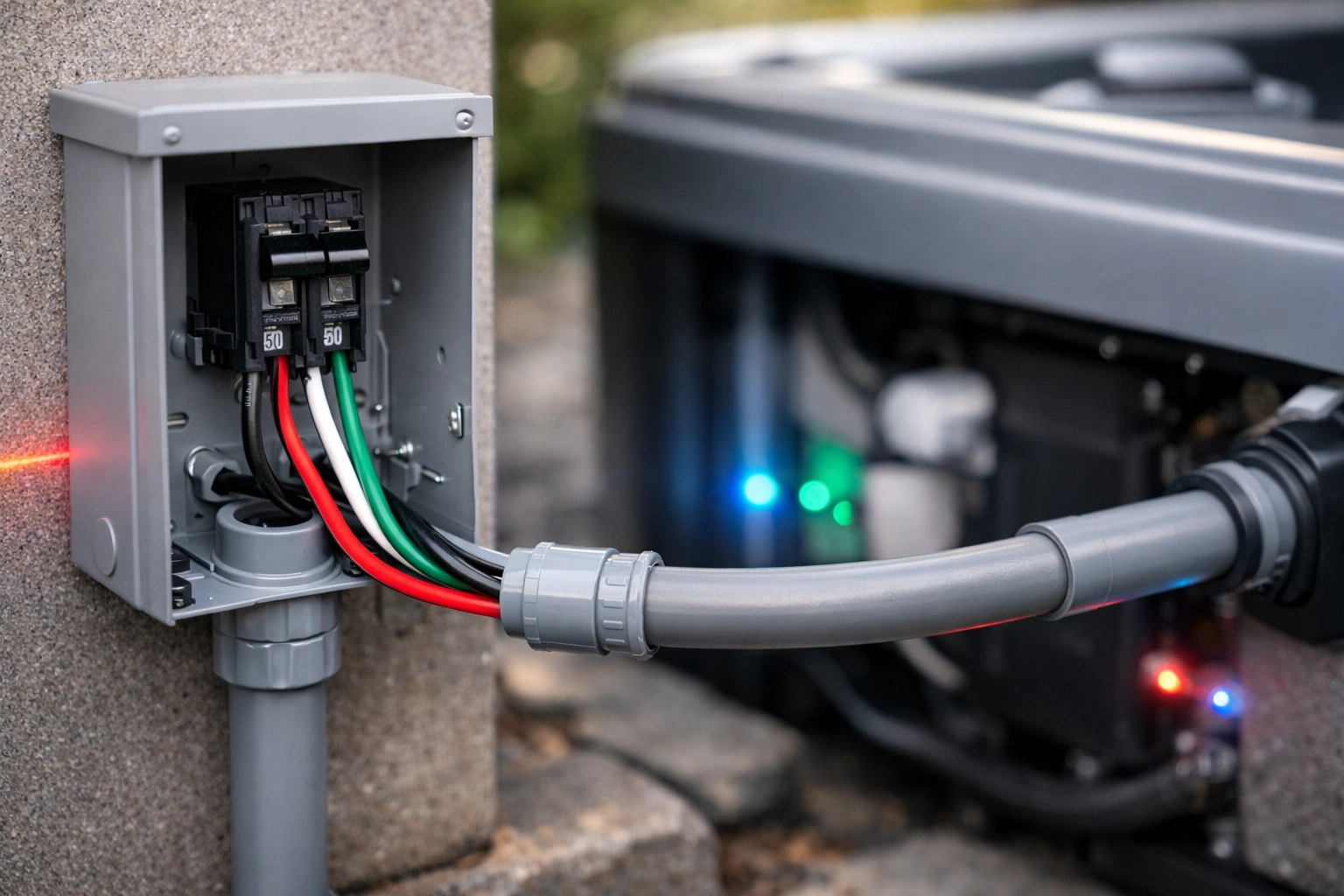
Next comes the disconnect switch. The National Electrical Code requires a manual disconnect installed within sight of your hot tub but at least five feet away. This gives you a quick way to cut power in an emergency without running back inside to your main panel.
This disconnect must include GFCI protection: either built into the disconnect box itself or at the breaker in your main panel. Many professional installations use an outdoor-rated GFCI disconnect box. These weatherproof units handle both functions in one convenient location.
All of this must be properly grounded. The grounding system provides a safe path for electricity to follow if something goes wrong, directing it into the earth instead of through your body.
And here's what separates amateur work from professional installation: proper conduit protection, weatherproof connections, correct burial depths for underground wiring, proper bonding of metal components, and meticulous attention to every detail in the electrical code.
Why Professional Installation Is Non-Negotiable
Look, we get it. You're handy. You've done some electrical work around the house. You've changed outlets and installed light fixtures. Maybe you're thinking you can handle this too.
Stop right there.
Hot tub wiring is not a DIY project. Period.
Here's why: The electrical code requirements for hot tubs are specific and complex. The safety stakes are incredibly high. And if you get something wrong: even something small: you could be creating a deadly hazard that won't show itself until someone gets hurt.
A licensed electrician knows exactly how to size the circuit correctly. We understand the nuances of GFCI protection. We know the proper wire gauges, conduit requirements, and grounding procedures. We've done this hundreds of times, and we've seen what happens when it's done wrong.
Plus, there's the legal side. Many jurisdictions require licensed professionals to perform hot tub installations. You'll need permits. You'll need inspections. Your homeowner's insurance might even require professional installation to maintain coverage.
At Steady-State Electric, we take pride in doing it right the first time. No comebacks. No corrections. No safety concerns keeping you up at night. Just professional, code-compliant work that gives you peace of mind every time you step into that hot tub.
We use American-made breakers, panels, and disconnect boxes. We pull the proper permits. We coordinate inspections. And we stand behind every connection we make.
Ready to Wire Your Hot Tub the Right Way?
Your hot tub should be a source of relaxation, not stress. Proper electrical installation ensures it stays that way.
Don't trust this critical work to anyone who isn't fully licensed and experienced with hot tub installations. The money you might save on a cheap installation isn't worth the risk to your family's safety.
We've been keeping homes and businesses safely powered for years. We know electrical work inside and out. And we're ready to make sure your hot tub is wired correctly from day one.
Ready to get started? Reach out to us and let's talk about your hot tub installation. We'll walk you through the entire process, answer all your questions, and give you a straightforward estimate with no surprises.
Because at Steady-State Electric, we believe in doing it right. Every time. Your safety depends on it.